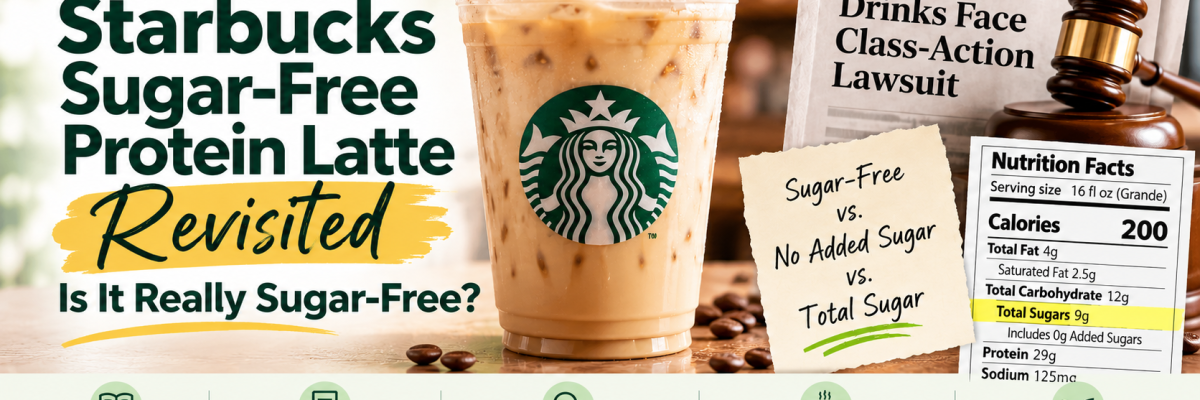
Starbucks Sugar-Free Protein Latte Revisited — Is “Sugar-Free” Really Sugar-Free? (Understanding sugar-free claims, protein-fortified beverages, and why you should look beyond food marketing). - Friday Food Talk
Last year, Nutripledge took a closer look at Starbucks' Sugar-Free Vanilla Protein Latte as part of our Food Coach product-rating series. Read our original Food Coach review.
Now, the beverage is back in the spotlight following a proposed
class-action lawsuit questioning the use of the term “sugar-free.”
This presents an excellent opportunity to revisit our original review
and, more importantly, help consumers understand what “sugar-free,” “no
added sugar,” and “total sugar” really mean.
These terms may sound similar, but they don't necessarily mean the same thing!
What's the Difference Between “Sugar-Free” and “No Added Sugar”?
According to the U.S. Food and Drug Administration (FDA), a product
labeled “sugar-free” generally must contain less than 0.5 grams of
sugars per labeled serving and per reference amount customarily consumed.
“No added sugar,” on the other hand, generally means that sugar or
sugar-containing ingredients were not added during processing, subject to FDA
labeling requirements. A product may still contain naturally occurring sugars.
For example, milk naturally contains lactose, a type of sugar. So a milk-based beverage may have zero grams of added sugar but still provide several grams of total sugar.
The Nutripledge takeaway: No added sugar does not necessarily mean sugar-free!
Starbucks Sugar-Free Vanilla Protein Latte: What Does the Nutrition Label Tell Us?
Let's revisit the Grande (16 fl oz) Starbucks Iced Sugar-Free Vanilla
Protein Latte.
According to the Starbucks nutrition information previously reviewed, one
Grande serving provides approximately:
|
Nutrient |
Amount |
|
Calories |
200 |
|
Protein |
29 g |
|
Total Carbohydrate |
12 g |
|
Total Sugars |
9 g |
|
Added Sugars |
0 g |
|
Dietary Fiber |
0 g |
|
Total Fat |
4 g |
|
Saturated Fat |
2.5 g |
|
Sodium |
125 mg |
The beverage contains milk, espresso, whey protein isolate, and
sugar-free vanilla syrup. The syrup includes ingredients such as sucralose, an
artificial sweetener.
Although Starbucks describes the beverage as containing no added sugar, it still provides approximately 9 grams of total sugar, primarily from naturally occurring lactose in milk.
Nutripledge FoodCoach: What We Like and What to Consider
What We Like
- Moderate
calories: Approximately 200 calories per Grande serving.
- High in
protein: Provides 29 grams of protein, which may be beneficial for
individuals with increased protein requirements.
- No added
sugars: According to Starbucks' published nutrition information.
- Relatively modest sodium: Provides approximately 125 mg per serving
What to Consider
- Total sugar: Contains
approximately 9 grams of naturally occurring sugar despite “Sugar-Free”
appearing in the product name.
- No dietary
fiber: Provides zero grams of fiber, a nutrient many Americans do not
consume in adequate amounts.
- Saturated fat: Contains
approximately 2.5 grams per serving, which should be considered within an
individual's overall dietary pattern.
- Additional ingredients: Contains whey protein isolate and sugar-free syrup with sucralose.
Nutripledge Food Coach Perspective
This beverage offers some nutritional benefits, particularly its
substantial protein content and lack of added sugars. However, consider its
overall nutritional value in the context of an individual's health goals,
protein needs, and dietary pattern.
The key takeaway is that a single nutrient or marketing claim does not determine a product's overall healthfulness.
Why Is Starbucks Facing a Lawsuit?
In October 2026, a proposed class-action lawsuit challenged Starbucks' use of the term “sugar-free” in the names of certain protein beverages. The plaintiffs allege that these beverages contain measurable amounts of total sugar despite being marketed as sugar-free. Starbucks disputes the allegations, maintains that its beverages contain no added sugar, and says consumers can access nutritional information. The lawsuit remains unresolved. Whether the product names violate applicable laws is a question for the court.
For consumers, however, the nutrition lesson is straightforward:
Read beyond the product name and understand what the nutrition information actually tells you.
Do We Really Need Protein-Fortified Coffee?
Protein is essential for maintaining muscles, supporting tissue repair,
and promoting overall health. However, more protein is not necessarily better
for everyone. Most Americans consume adequate amounts of protein, while dietary
fiber remains a commonly under consumed nutrient.
Protein needs vary by age, activity level, health status, and other factors. Protein-fortified beverages can be convenient and beneficial for some people, especially those with higher protein needs or difficulty meeting their requirements through regular meals. However, if someone already gets enough protein from a balanced diet, adding 29 grams of protein to a daily coffee may be unnecessary.
At Nutripledge, we encourage a food-first approach whenever practical.
Whole and minimally processed plant foods such as beans, lentils, soy
foods, whole grains, nuts, and seeds provide protein along with dietary fiber,
vitamins, minerals, and other beneficial plant compounds.
These foods offer more than protein alone and can support overall health and wellness.
A Nutripledge
Healthier Alternative
If you enjoy coffee, consider a simple cup of freshly brewed coffee with
a splash of unsweetened milk or an unsweetened plant-based beverage. Add
cinnamon or another favorite spice for natural flavor without relying on
sweetened syrups.
Rather than relying routinely on protein-fortified beverages, consider
obtaining much of your daily protein from whole and minimally processed foods.
When comparing packaged foods and beverages, use the Nutrition Facts label to guide your choices.
The goal isn't to fear food. It's to understand it.
Next time you buy a product labeled “sugar-free,” take a moment to check
its total sugar and added sugar content.
You might be surprised by what you discover!
Food is medicine—eat with intention, responsibility, and confidence to support your whole health and well-being!
Disclaimer! Please note that this page is not medical advice. It offers only general guidance for a healthy and balanced diet. This food does not guarantee an adequate or safe intake level for any individual. Please consult your healthcare provider and explore our Medical Nutrition Therapy services for a meal plan tailored to your needs.